
Low-observable drones.
A last-line answer to theirs.
Two programmes. The Toothless line: low-signature unmanned systems across air, sea and land. Black Dragon: a last-line hard-kill counter-drone shield, soldier-carried or vehicle-mounted. A mobile phalanx, an iron dome the squad can move with.
Engineered to a drawing, built to a tolerance, inspected on the same revision.
One programme.
Three domains.
Toothless is a family of low-signature vehicles built around a shared design discipline: minimise what a modern counter-UAS stack can key on. Air, sea, land.
Launched-effects family. An unpowered glider carrier delivers small, dark, gliding effectors into the terminal envelope.
Encapsulated undersea effector. Non-ferrous hull, dormant on the seabed, wakes on signature or command.
Ground vehicle sized to hug cover. Low visual, low thermal, low radio footprint.
Toothless line.
A mobile phalanx for the dismounted soldier.
Black Dragon is a last-line hard-kill shield against drones. Soldier-carried or mounted on a ground vehicle. Think phalanx of the old infantry, or an iron dome the squad can move with. Aim by hand, fire, reload from a magazine. No network, no upstream sensor, no per-shot approval.
Manpackable or vehicle-mounted firing mount. A mobile phalanx shield for the dismounted soldier. Human-in-the-loop, no network, no upstream sensor.
Close-in magnetic-influence proximity fuze. Keys on the target's motor and current-loop signature. Point and shoot, just get it close.
Detection has moved. Design has to move with it.
Ground and airborne quantum magnetometer arrays (optically-pumped and NV-diamond) are now credible against low-observable UAS. They are passive, work in fog and darkness, ignore birds, and defeat RF-silent, pre-programmed vehicles that hide from radar and RF sniffers.
Signature is treated as a first-order design constraint on every Toothless vehicle: magnetic, acoustic, thermal, radar and RF. Non-ferrous structure where practical, current-loop shaping, quiet propulsion, disciplined emissions. We do not claim undetectable. We claim signature below the threshold of the sensors we design against, at the ranges those sensors are used.
- Quantum magnetometry (OPM, NV-diamond)
- Passive coherent radar and RF DF
- Acoustic pickets and camera arrays
- MAD-equivalent airborne ASW
- Non-ferrous or composite primary structure
- Current-loop routing, shielding, cancellation
- Emissions control and terminal-only wake-up
- Acoustic and thermal budgets held per drawing
The squad has no organic C-sUAS.
Every serious C-UAS study of the last two years reaches the same conclusion. The threat that reaches the last hundred metres, autonomous, RF-silent, GPS-guided or fibre-tethered, arrives inside every upstream sensor and every upstream shooter. The layered defence assumed by doctrine is not present at the tactical edge. Radar loses the target in ground clutter, RF jammers have nothing to jam, and vehicle-mounted air-defence is somewhere else.
Black Dragon is designed for that gap. A mobile phalanx shield for the soldier, or an iron dome bolted to a light vehicle. Manpackable, kinetic, human-in-the-loop. Cost per engagement measured in dollars, magazine depth measured in rounds. Aim it, fire it, get close.
An SR-71 shaped glider,
married to a high-aspect-ratio ultralight.
The company name traces to the SR-71 Blackbird. Picture that planform as an unpowered glider drone: high aspect ratio, blended body, no engines, no heat, no radios. It rides a high-aspect-ratio, twin-prop ultralight glider for the long unpowered ingress, wrapped in an RF-absorbing skin with emissions disciplined to zero. Near the objective it dispenses a magazine of small gliding effectors that fold out their lifting surfaces and descend silent. Onboard sensors and radios stay inhibited until the terminal window. The RF sniffers, passive coherent radars and acoustic pickets that make up the middle of the counter-UAS stack have nothing to key on until it is already too late.
- High-aspect-ratio ultralight glider, unpowered ingress
- RF-absorbing skin, minimised RCS aspect
- Emissions disciplined across the mission
- Magazine of dispensable glider effectors
- Stowed for release, fold-out lifting surfaces
- Gliding descent, no propulsion signature
- Sensors and radios inhibited until terminal
- Terminal wake-up, act, done
Framed in US Army and Air Force doctrine, this is a Launched-Effects (LE) architecture with the carrier acting as an attritable delivery vehicle. Signature reduction is treated by band and aspect, not as a slogan. All claims will be reduced to measurement against a named baseline before any programme conversation.
Encapsulated undersea effector.
Distributed area denial.
A pre-positioned undersea effector: seabed-resting, dormant, low power. It wakes on acoustic signature or external command, resolves the target, and prosecutes. The operational effect is area denial: enough distributed effectors in a chokepoint impose simultaneous prosecution demands on an adversary's ASW and torpedo-defence resources, and degrade their ability to sanitise the water they need to operate in. Concept lineage traces to Hammerhead-style encapsulated effectors and DARPA Upward Falling Payloads.
- Chokepoint seeding, patient stand-off
- Acoustic-signature or command wake-up
- Distributed magazine, simultaneous prosecution
- Cost-per-engagement favours the defender at scale
- Non-ferrous pressure structure (aluminium / composite)
- No permanent magnetic moment to fix on
- No induced signature drift from wave cycling
- No deperming schedule, no dockside reset
Steel hulls acquire a permanent magnetic moment over time, held in the geomagnetic field and beaten in by the seaway, which is why merchant tonnage and combatants deperm at dockside degaussing ranges. A vehicle built without that ferrous mass has no equivalent to reset. Detectability against emerging quantum magnetometry ultimately depends on sensor mission and geometry; we treat the axis we control as a first-order design constraint and track MRL on counter-QM signature management as it matures.
Concept sheet.
Working artwork. Indicative, not final.
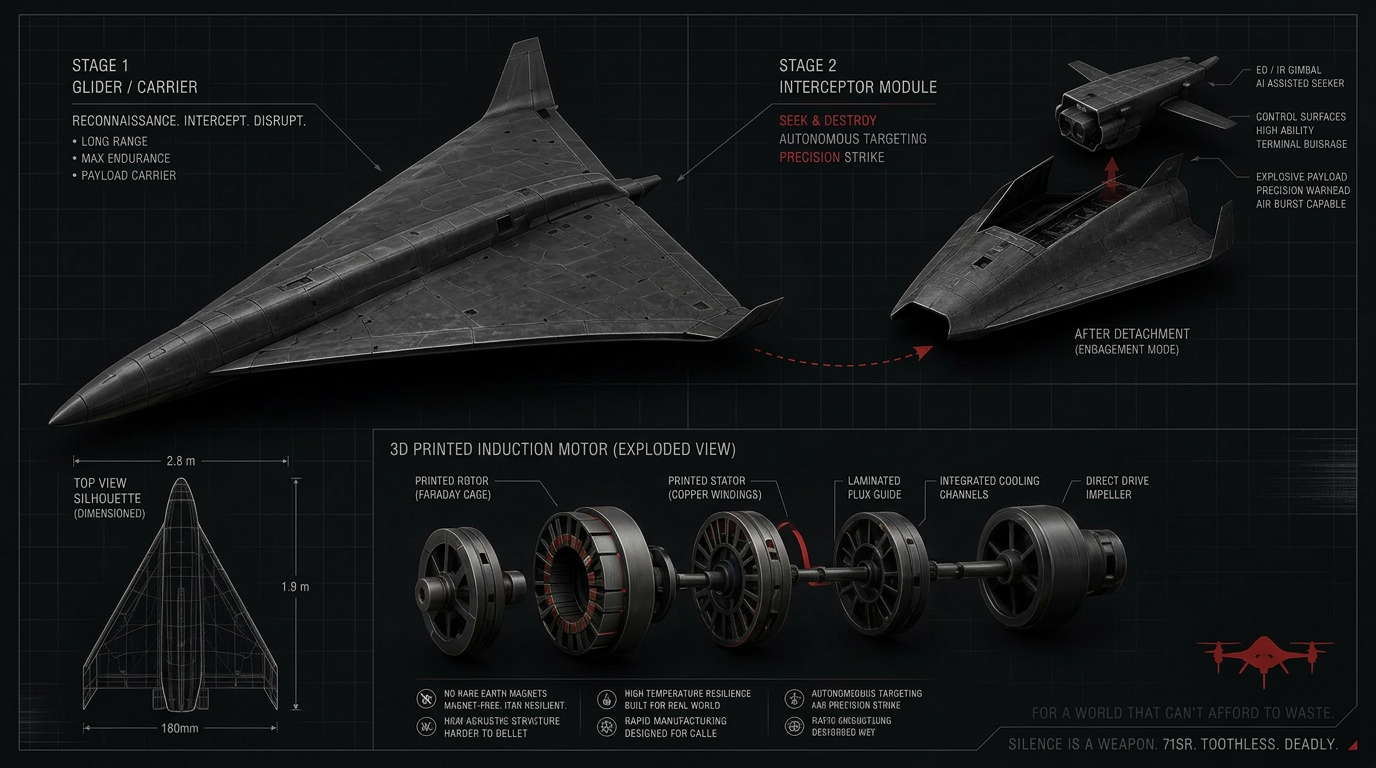
3D printed.
No magnets.
Induction motors, additively manufactured with our motor division MotorDope. Printed where they're needed. No rare-earth supply chain.
- no rare-earth magnets
- printed in-region
- inspectable at every layer
- field repairable
Additive induction motor.
Squirrel-cage rotor. Printed stator. No permanent magnets and no rare-earth dependency. The motor is co-developed with MotorDope, our motor division.
Additive manufacturing is chosen for supply-chain reasons before it is chosen for geometry. The motor is meant to be printed where it is needed.
why induction
why additive
Corporate Disclosure
71SR is a private engineering company. The platform separates observation from action.
Independently held. Defensive posture.
- Not offering securities publicly.
- Not publishing a roadmap.
Inquiries are answered directly.
Engineering notes.
Selected. Expanded entries reflect what is safe to publish at this revision.
note-033 · manufacturing · build-to-print
We build to the drawing. Anything that cannot be drawn, toleranced and inspected does not ship. Engineering, shop floor and field stay on the same revision of the same document, and revision discipline is kept cheaper than rework.
note-021 · mission · loiter and recovery envelope
The on-station band is sized so that re-tasking latency is bounded by sensor cadence. Recovery is bracketed by handoff to a stationary asset.
note-029 · spectrum · superiority as a defensive posture
Spectrum control is treated as an extension of the shield. Counter-electronics authority is held in reserve.
Development log.
Public excerpts. Internal entries are not mirrored here.
[PROP] motordope · stator print v0.3 holds tolerance across thermal sweep.[RF ] sidelobe budget rewritten; new mask passes against reference set.[SYS ] decision-loop latency at edge: p99 within bound.[MFG ] aft mount consolidated to a single drawing revision. rework dropped.[OPS ] on-station envelope clarified; recovery bracketed by stationary handoff.
Dragon Works Division.
The internal program office. Small teams, build-to-print discipline, written arguments.
A working name for the part of 71SR that ships the harder articles.
Direct inquiries
are welcome.
Substantive correspondence is answered directly.
CONTACT